
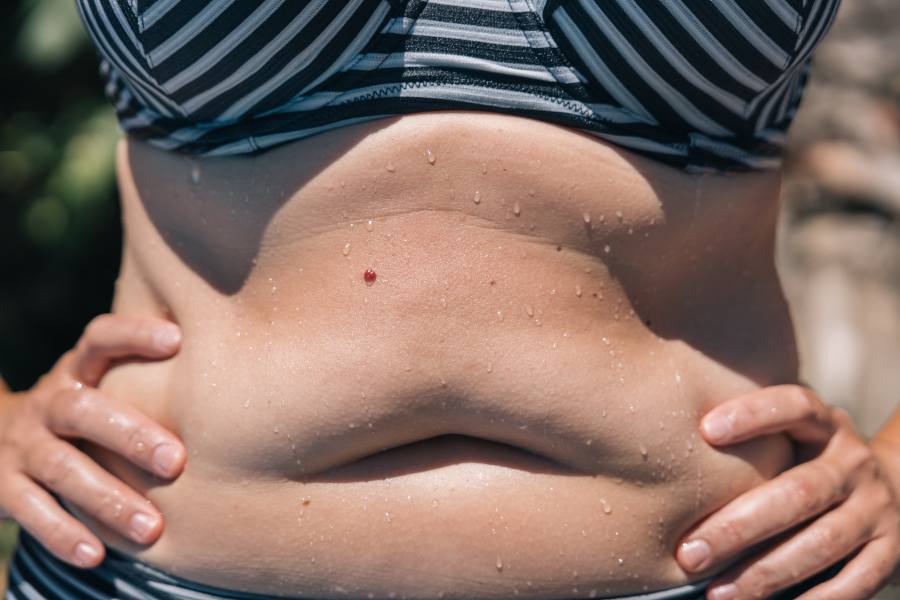
You went through liposuction. The before-and-after photos were great. A year or two later, you notice your jeans fit oddly, your bra digs in differently, and the weight you gained back didn’t go where you expected. You’re not imagining it.
Quick answer: Liposuction permanently removes fat cells from treated areas. If you gain weight afterward, the remaining fat cells in other parts of your body can grow larger, and in cases of bigger weight changes, new fat cells can form. That’s why weight regain after lipo often shows up in places you didn’t expect, like the upper back, knees, or arms. Many women see this most clearly after a mommy makeover and a later pregnancy or a stretch of poor sleep.
This piece walks through what’s actually happening inside your body, what the peer-reviewed studies say (including the ones that disagree), and when uneven weight gain is something to bring to a surgeon.
The Short Answer: Why Liposuction Results Can Look Lopsided Later
Three things drive uneven weight gain after lipo:
- Fewer fat cells in treated zones. Lipo removes them. They don’t grow back in those spots.
- Existing fat cells elsewhere can grow. A process called hypertrophy.
- New fat cells can form with significant weight gain. A process called hyperplasia, confirmed in a 2025 Swedish cohort study published in ScienceDirect.
So if you regain 15 pounds, that weight has to go somewhere. With fewer cells in your flanks or thighs, your body uses whatever storage capacity it has left.
What Actually Happens to Fat Cells After Liposuction
Here’s where science gets interesting.
A landmark study by Spalding and colleagues at the Karolinska Institute, published in Nature in 2008, found that the total number of fat cells in your body is mostly set by adolescence. Adults turn over about 10% of their fat cells per year, but the overall count stays steady, whether someone is lean or obese.
A 2025 follow-up Swedish cohort study refined that finding. Fat cell number stays stable during normal adult life and doesn’t drop with weight loss, but it can climb during meaningful weight gain. Fat cell size, on the other hand, moves up and down with weight constantly.
Hypertrophy vs Hyperplasia: Two Ways Fat Grows
- Hypertrophy: Existing fat cells store more lipids and get bigger.
- Hyperplasia: Precursor cells turn into new fat cells.
For reference, a healthy adult fat cell measures around 63.4 μm in diameter (range 59 to 72 μm). In obesity, those same cells can swell to 200 μm. That’s data from a 2022 paper in Frontiers in Cell and Developmental Biology and a related bioRxiv preprint.
Translation: even without forming new cells, your existing fat cells have a huge amount of room to expand if you gain weight.
Does Fat Really Redistribute After Lipo? The Studies Disagree
This is the most-debated question in liposuction research. Most blogs duck it. Here’s what each side actually shows.
The ASPS position (Swanson, Plastic and Reconstructive Surgery, August 2012): Dr. Eric Swanson, an ASPS member surgeon in Leawood, Kansas, studied 301 liposuction patients (some with abdominoplasty). He found no evidence of fat regrowth in treated areas and no measurable upper body changes that would suggest redistribution. A 2014 follow-up in the Aesthetic Surgery Journal showed the same pattern for breast size.
The contrary finding (Hernandez et al., Obesity journal): A randomized controlled trial of 32 nonobese women, tracked with MRI, found that body fat was restored after suction lipectomy and redistributed from the thigh to the abdomen.
The Brazilian RCT (Benatti et al.): Found that liposuction triggered a compensatory increase in visceral fat, but the effect was completely offset by physical activity in patients who exercised after surgery.
How to Make Sense of Conflicting Studies
| Study | Population | Finding | Implication |
| Swanson 2012 (n=301) | Mixed lipo and lipo plus tummy tuck patients | No fat regrowth, no upper body redistribution | Stable weight means stable results |
| Hernandez et al. (n=32) | Nonobese women, MRI tracked | Fat returned, shifted thigh to abdomen | Redistribution can happen |
| Benatti et al. RCT | Women after small-volume abdominal lipo | Visceral fat rose, exercise reversed it | Behavior matters more than surgery |
The honest read: the removed cells are gone. Whether weight regain shows up unevenly depends on weight stability, activity level, hormones, and genetics.
Why Mommy Makeover Patients See Different Patterns
Pregnancy rewrites the rules. After kids, the body holds and shifts fat differently, and a previous surgery doesn’t change that biology.
Pregnancy Hormones Shift Where Fat Lives
Estrogen drives fat storage to the hips, thighs, and buttocks for energy reserves to support pregnancy and breastfeeding. After delivery, that fat slowly redistributes, but not always back to where it sat before.
Research from Korea University Guro Hospital found that fat mass and visceral fat area increase postpartum even when overall weight goes down. So the scale can drop while the belly looks fuller.
Data from the Pregnancy Risk Assessment Monitoring System (PRAMS) shows only 48% of women return to their pre-pregnancy weight by 12 months postpartum. The average long-term retention is 2 to 5 pounds per pregnancy. Studies cited by PMC report that postpartum weight retention affects up to 75% of women.
Breastfeeding Doesn’t Always Equal Weight Loss
Yes, breastfeeding burns roughly 300 to 500 extra calories per day. But prolactin (the milk-making hormone) also bumps appetite up. Many new moms eat more than the deficit, and the body tends to keep fat reserves on the hips and thighs as a safety net for milk production.
Sleep Deprivation, Cortisol, and Belly Fat
This is the part nobody warns you about.
Chronic sleep loss in the first year postpartum keeps cortisol levels elevated for months. Cortisol promotes belly fat storage and pushes the body to use muscle (not fat) for energy when you’re under-rested.
Stanford Lifestyle Medicine notes that sustained high cortisol raises blood insulin, which feeds belly fat storage and bumps the risk of prediabetes and type 2 diabetes. Scientific American adds that sleep-deprived dieters lose more muscle and gain more fat than rested ones.
So if your liposuctioned thighs still look great but your midsection feels softer than before, sleep and stress may be doing more than diet.
Want a clear read on where things have shifted? Toronto Cosmetic Clinic offers in-person assessments with board-certified plastic surgeons who can map what’s actually changed since your last procedure. Book a consultation and get specifics for your body.
How Genetics Shape Where Fat Comes Back
A University of Sydney report (November 2023) found that genes account for around 60% of fat distribution patterns. That’s a big deal.
Two women can have the exact same procedures, regain the same five pounds, and see fat reappear in completely different spots. One on the knees. One on the bra-line. Both are normal.
Female fat storage is also biologically tilted toward the hips, thighs, and buttocks because of pregnancy and nursing biology. Women tend to lose weight first from the face, calves, and arms because those areas affect childbearing the least.
When a Tummy Tuck Changes the Picture
A tummy tuck doesn’t just remove fat. It removes loose skin and repairs the abdominal muscles that often separate during pregnancy (a condition called diastasis recti).
Per Dr. Jaime Schwartz (December 2025), strength training alone can’t tighten loose connective tissue. A tummy tuck can.
The combination of lipo plus a tummy tuck changes how the abdomen behaves with later weight gain. Per the Swanson 2012 data:
- Average weight change after lower body liposuction alone: just over 2 lbs.
- Average weight change after lipo plus tummy tuck: about 4.5 lbs.
A tightened wall and a reduced fat depot mean small weight gain may shift visibly to the upper back, arms, breasts, or thighs instead of pooling in the belly. Dr. Christopher Patronella (Houston, January 2026) put it plainly: each person’s metabolic code decides where weight lands.
The GLP-1 Factor in 2025 and 2026
This one’s new. The 2024 ASPS Procedural Statistics Report tracked GLP-1 medication use among aesthetic patients for the first time:
- More than 800,000 aesthetic patients used GLP-1s in 2024.
- 20% of GLP-1 patients have already had plastic surgery.
- 39% are considering surgical procedures.
- 41% are considering non-surgical procedures.
Here’s the catch for mommy makeover patients: if you lost weight on a GLP-1 after delivery, had your procedure at that lower weight, and then stopped the medication, the fat cells you have left can enlarge significantly. Lipo cells in treated zones can’t grow back, but everywhere else has more room to expand. That can create the most dramatic uneven pattern of all.
When Is Uneven Weight Gain Normal, and When Is It a Problem?
Normal: Small shifts in shape after weight stability changes, especially after pregnancy, breastfeeding, or stopping a weight-loss medication.
Worth a consult: When the change feels disproportionate, asymmetric, or includes physical symptoms.
Watch for:
- Firm, painful, or hard lumps in treated areas. Fat necrosis happens when fat cells die and harden into firm lumps. It requires evaluation, not self-treatment, per Liv Hospital, April 2026.
- Asymmetry that develops over time (not the swelling-related kind right after surgery).
- Persistent contour dents or ripples that get worse with weight changes.
- Significant weight gain in body zones that look out of step with the rest of you.
Revision Liposuction: When It Helps
Around 6 to 10% of liposuction patients pursue a second procedure, usually after waiting the recommended 6 to 12 months for healing and tissue remodeling, per Minneapolis Liposuction Specialty Clinic (July 2025) and Vegas Liposuction (June 2025).
What Revision Lipo Can Fix
- Asymmetry between treated areas.
- Indentations or contour dents.
- New fat that appeared in untreated nearby zones.
- Changes from weight fluctuations after the first procedure.
Why Revision Is Trickier Than Primary Lipo
Per Dr. Joel Beck on RealSelf, scar tissue and altered anatomy make revision more delicate. Surgeons often use slower, more conservative technique and wait up to a year so scar tissue softens. Sometimes the answer is liposhifting (moving fat instead of just removing it) or fat grafting rather than more removal.
A High Definition Liposuction source noted that irregularities are usually worsened by weight fluctuations involving both loss and regain, which is exactly what many postpartum women experience.
What to Ask at Your Consult: The Post Mommy Makeover Body Map Review
If you’re booking a consult specifically about uneven weight gain after a previous procedure, here’s a four-point framework we use at Toronto Cosmetic Clinic:
- Treated-area integrity check. Has anything changed in the original lipo zones? Skin quality, contour, lumps?
- Untreated-area redistribution mapping. Where exactly has the new fat shown up? Subcutaneous or deeper visceral?
- Hormonal and lifestyle factor review. Pregnancy plans, breastfeeding status, GLP-1 use, sleep quality, cortisol triggers.
- Revision vs touchup decision matrix. Is this a candidate for revision lipo, fat grafting, a non-surgical option, or simply more time?
This kind of in-person mapping is harder to fake or self-diagnose. Photos and mirrors can both miss subtle shifts. A trained surgeon doing a hands-on assessment usually doesn’t.
Toronto Patients: Why Your Clinic’s Inspection Record Matters
In Ontario, any plastic surgery clinic doing tumescent liposuction (the standard technique) falls under the CPSO Out-of-Hospital Premises Inspection Program (OHPIP).
A few facts worth knowing:
- The College of Physicians and Surgeons of Ontario was granted authority for the program in 2010 to fill a gap in cosmetic clinic oversight.
- All out-of-hospital premises are routinely inspected every 4 years, or sooner if CPSO sees a reason.
- New or relocated clinics are inspected within 180 days of notification.
- Since January 31, 2013, inspection results have been publicly posted on the CPSO website, one of the most transparent systems of its kind in Canada.
If you’re considering any kind of revision or future procedure in Toronto or North York, check the CPSO clinic listing before you book. It costs nothing and tells you everything about whether the facility meets provincial standards.
A Note on Cost
Liposuction and mommy makeover procedures are not covered by OHIP because they’re elective. Costs vary widely by procedure scope, facility, and surgeon. Get a quote directly from a board-certified plastic surgeon for your situation, since published ranges go out of date quickly.
2024 Industry Context (For Perspective)
From the ASPS 2024 Procedural Statistics Report (released June 2025):
- Liposuction: 349,728 procedures (up 1% from 2023, still the #1 cosmetic surgery).
- Breast augmentation: 306,196 procedures.
- Abdominoplasty (tummy tuck): 171,064 procedures.
- Breast lift: 153,616 procedures.
ISAPS’s 2024 Global Survey, released in June 2025, recorded more than 17.4 million surgical procedures globally, with liposuction remaining the top surgical pick for women. Over four years, overall procedure volume rose 42.5%.
You’re not the only one re-evaluating your results. The patient pool is larger than ever, and revision conversations are happening more often.
Frequently Asked Questions
Why is my upper back getting fuller after abdominal liposuction?
Your body needs somewhere to store fat if you gain weight. With fewer cells in your abdomen, areas like the upper back, bra-line, and arms have more proportional storage capacity left. It’s a mechanical and biological reality, not a surgical mistake.
Can a second pregnancy ruin mommy makeover results?
It can change them, yes. Pregnancy stretches skin and abdominal muscles again and triggers fat storage patterns that mirror the previous pregnancy. Many surgeons recommend waiting until you’re done having children before a mommy makeover for that reason.
How long do liposuction results last after pregnancy?
If your weight stays stable, the treated areas keep their improved contour permanently. The fat cells removed don’t grow back. What changes is what happens around them with future weight gain, hormones, and aging.
Is post-pregnancy fat redistribution permanent?
Often, no. Most women return to their pre-pregnancy fat pattern over months to years, but a portion (the 2 to 5 lbs PRAMS retention figure) tends to stay. How quickly it normalizes depends on activity, breastfeeding, hormones, and sleep.
When is a firm lump after liposuction a problem?
Soft swelling for weeks after surgery is expected. A firm, persistent, or painful lump months after lipo should be evaluated. Fat necrosis is one possibility. A scar tissue nodule is another. Either way, your surgeon should see it in person.
Can I get revision liposuction if fat came back in a completely different area?
Yes, if you’re medically eligible and weight-stable. Revision can address untreated zones, asymmetry, or contour issues. Most surgeons wait 6 to 12 months after the original procedure to let healing settle before assessing.
Does fat redistribute everywhere after lipo, or just to certain zones?
The evidence is mixed. Swanson’s 2012 study found no measurable redistribution in stable-weight patients. Hernandez’s RCT in nonobese women found fat moved from thighs toward the abdomen. The Benatti trial found visceral fat rose unless patients exercised. Behavior, hormones, and genetics matter as much as surgical technique.
Ready to Map What’s Actually Going On?
If your post-lipo body doesn’t look the way it did a year or two ago, you don’t have to guess. A proper in-person assessment can sort out what’s redistribution, what’s hormonal, what’s hypertrophy, and what’s worth correcting.
The team at Toronto Cosmetic Clinic, based in North York, offers consultations with board-certified plastic surgeons who can walk through the Body Map Review framework above and tell you, honestly, whether revision, a non-surgical option, or simply more time is the right call.
Book a consultation to get specifics for your body, your history, and your goals.